WTF!! West Texas FIASCO

Brent crude oil is a benchmark price for about two thirds of the world’s oil contracts. This influential benchmark, which is based on five specific grades of crude oil produced in the UK and Norway and sold FOB North Sea ports, stands at a crossroads: the trading community is being asked to accept the inclusion of the USA’s West Texas Intermediate (WTI) crude oil as a deliverable grade in the Brent benchmark contracts.

The reason for this proposal is to boost the volume of oil that is potentially available to be traded and provide a database of transactions that can be considered in the daily price assessments of the price reporting agencies (PRAs). The volume of crude that can set the price of Brent is on an ever-declining trend. Furthermore, not all of the actual deals done in Brent oil find their way into the price assessment process.

It is hoped that the inclusion of WTI will boost the volume of trade that can inform price assessments and protect the benchmark from being manipulated. But the fundamental adjustments that would have to be made to what we call “Brent” to accommodate the inclusion of WTI raise a number of questions

How Important is Brent? Why Should We Care?

“Brent futures” is the title of the flagship contract of the Intercontinental Exchange (ICE) that trades 96 calendar months into the future. Between January and May 2022 the ICE Brent contract traded roughly 235 times more volume of Brent than total world production of all grades of oil worldwide over the same period.

Much more difficult to estimate is the considerably greater volume of over-the-counter (OTC) derivative swaps and options contract that trade worldwide within the International Swaps and Derivatives Association (ISDA) master contract framework.

The vast majority of physical contracts that use Brent as a reference price use the particular assessment published by the PRA, Platts, although such prices are also reported by their main rival, Argus Media, and the newcomer, General Index.

The Brent benchmark has evolved over the years from the 1980s into a very complex system for generating prices each day that can be plugged into contracts by companies and governments around the world many of whom have no direct market involvement themselves. It is taken on trust that the benchmark they are using is representative of the “true” market value of oil.

What is Brent Currently?

To recap, what we call Brent currently has the following characteristics:

Brent physical, or “cash”, contracts and the quasi-physical forward contracts are largely unregulated. No-one has the mandate to dictate how companies construct physical oil contracts. The PRA, Platts, has stepped into this regulatory void by simply excluding from the database of transactions it uses to assess daily Brent prices any deals that are not compatible with the methodology laid down by Platts. This methodology is complex and detailed[1]. The number of companies actually inputting data to Platts is limited and these can only contribute data into the “Market on Close” (MOC) price assessment process, if, and for as long as, they have been approved by Platts to do so[2].

The oil trading community continues to use the Platts Brent benchmark as the calculation reference price in its unrelated contracts. The majority of companies that use the Brent benchmark tend not to have the expertise or the market involvement to participate in the MOC price assessment process. Those that can and choose to participate in MOC activities have only to focus for a limited time period every day, the so-called “window”, which concentrates trades into 30-45 minutes before the close.  This gives them input to the Brent price that is published every day by the PRAs, without the need to transact large volumes of oil throughout the day to demonstrate their belief in any particular price level.  Some active oil and trading companies choose not to participate in MOC or the window, as a conscious policy decision.

The execution of MOC trades transacted in the Platts window is carried out on the ICE trading platform using the ICE matching engine.

The Proposed Inclusion of WTI in Brent

It has now been announced by Platts that the Brent basket they consider in their Brent assessment will be expanded to include WTI Midland crude oil from June 2023. Companies are not obliged to comply by changing their contract methodology, but if they do not their deals will not qualify for inclusion in the published price assessment.

WTI Midland is an emerging benchmark in its own right[1]. Since the ban on crude exports from the USA was lifted in December 2015, WTI has and continues to become a key export grade in the international market. The volume involved is well in excess of 1 million b/d although the current picture is obscured by releases from the US Strategic Petroleum Reserve in response to the war in Ukraine. Total US exports are much higher from the USGC, but not all is WTI that has been collected at Midland.

The export logistics for WTI crude are still evolving. Comparatively stable quality light, sweet crude from the Permian Basin are collected at Midland Texas, and other gathering stations, and are exported from the ports of Houston, Corpus Christi and the Beaumont/Port Arthur/Nederland US Gulf Coast (USGC) area. This is a work- in-progress because additional storage and jetty capacity is still being added in the Texas area.

Standardisation, control and clarity of US exports from the USGC are likely to emerge over time but do not yet exist and are unlikely to exist by June 2023 when Platts would like to annex WTI Midland volume to bolster the crumbling Brent benchmark.

“Platts Assessment Methodology Guide, March 2022” and “Specifications Guide Europe and Africa Crude Oil, February 2022”.

https://www.spglobal.com/commodityinsights/process/moc-participation-review-process

“Argus Media Texas Ports Guide: Fall 2020 Edition”.

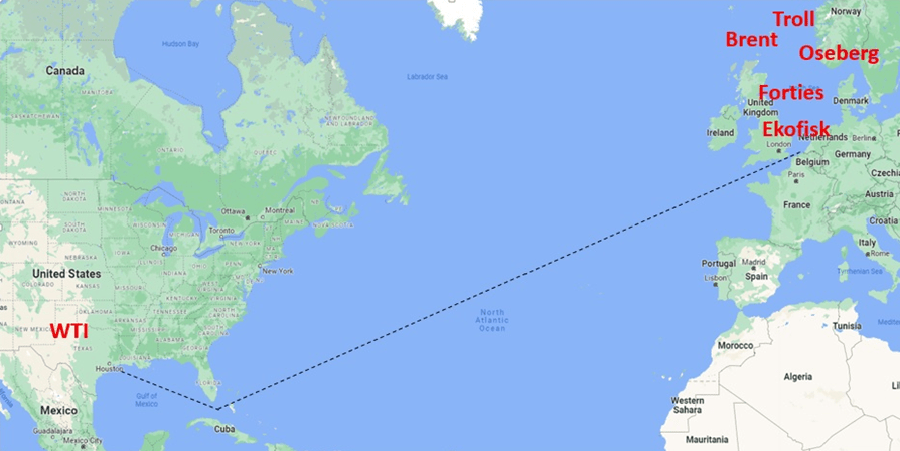
The Location of a major WTI gathering point in Midland, Texas

“Argus Media Texas Ports Guide: Fall 2020 Edition”.

The Location of WTI Midland:

Unsurprisingly, commercial entities with a vested interest in prolonging the life of Brent are keen to appropriate the tempting volume of WTI Midland into the Brent basket. However, in order to accommodate WTI, it is recognised by the PRAs that the Brent contract and Brent price assessment process would need some fundamental modifications.

Shell, the widely accepted custodian of the general terms and conditions of trade (GTCs) in the Brent market, are proposing further amendments to their time-honoured Shell UK (SUKO) 1990 GTCs to accommodate WTI Midland[1].

Cargo Scheduling

The first issue to arise is that there is no terminal operator in the USGC accustomed to compiling and circulating a monthly schedule of standard-sized cargoes that are aggregated in accordance with standard terminal operating procedures and which are available for lifting and sale on standard contract terms. The North Sea terminal operators for Brent, Forties, Oseberg, Ekofisk and Troll release such monthly schedules on compatible, if not coordinated, timetables. The lack of similar data for WTI Midland makes it tricky to decide when cargoes exported from the USGC would arrive in Northwest Europe to qualify for inclusion in Brent.

There is no publicly available, “official” information released in advance about when WTI cargoes will actually leave the Houston area to embark on an approximate 6,000 nautical miles journey to Rotterdam[2]. It is difficult to establish when WTI cargoes would reach the Rotterdam European reference destination port, or any other port to which the buyer may require delivery to its own refinery. At an environmentally- friendly 10 knots this journey would take about 26 days. At a “caps-on-backwards” rate of 15 knots this would take 17 days.

So, there would be some doubt about into which 30-Day BFOET contract month such WTI cargoes would qualify for delivery. This is particularly problematic when there is steep backwardation or contango[3] in the market. When there is a big price difference for oil to be delivered on different future dates, the slippage of a WTI Midland cargo’s delivery date from one month to the next would make a substantial difference to the value of the cargo.

FOB or CIF?

Including WTI sales made FOB the USGC would not make a lot of sense for the FOB North Sea Brent basket. So, SUKO proposes including WTI Midland on a CIF Rotterdam basis and adjusting the price for the difference in the cost of freight from the USGC to Rotterdam and the North Sea to Rotterdam.  SUKO proposes using Platts freight cost  assessments to adjust for this distance differential.

As mentioned above the seller, rather than the buyer as in an FOB sale, would charter the tanker in a CIF sale. So vetting tankers in advance to perform the voyage becomes an issue that is not relevant to an FOB sale in the North Sea.

Buyers of oil FOB North Sea ports must have their tankers vetted as acceptable to the relevant seller and North Sea terminal in the 7-10 days before it loads. But buying a 30-Day contract that may turn out to deliver a WTI cargo to Rotterdam at the seller’s option and in the seller’s tanker, is another matter. The tanker has to be acceptable to the buyer, but it is unclear what would  happen under a 30-Day “BFOETW” deal, if that is the contract from June 2023,  if WTI is the grade declared by the seller and the buyer does not approve the seller’s tanker. Presumably the 30-Day notice period gives the seller time to propose a different tanker although, if the buyer has its own vessels on time charter or under a contract of affreightment, reaching agreement may be problematic.

Cargo Size

A further modification to standard Brent trading practice includes increasing the “Brent” cargo size from 600,000 to 700,000 bbls to reflect transatlantic freight economics. Economies of scale dictate that larger tankers are used to ship oil over longer distances. This requires a change in trading practices by  North Sea producers who typically accrue or co-load 600,000bbbl parcels under their lifting agreements with the terminal operators. There is no obvious reason why upstream producers should cooperate in this fundamental change to long-established joint operating agreements, transportation agreements and lifting agreements for the convenience of PRAs, even though the upstream producers’ own traders might support it. Many producers do not have a trading department to provide an opinion to their upstream colleagues.

Quality and Origin

In response to concerns over uncertain quality expressed by pioneering international buyers of WTI, when it first became an export grade, both Shell and Platts have stipulated quality specifications for WTI Midland as delivered FOB, including an API gravity range of 40-44o, total sulphur content of up to 0.2% and limits on bottoms, sediment and water (BS&W), reid vapour pressure (RVP) and heavy metals. Shell has also stipulated limits on organic chlorides and some distillation parameters.

Platts has defined a certain number of pipelines that bring WTI Midland to the USGC as being eligible sources for their export price assessments.

Says Ben Holt, Consilience Senior Associate[4], “At this stage there appears no plan to introduce a quality adjustment for WTI as exists for the other non-Brent grades, but Platts say they will keep this under review.  WTI is lighter and sweeter than most of the other grades in the Brent basket (Brent is quoted by Platts as 37.5 API  and Sulfur 0.4%) so as the relative refined product values of the different crudes change,  WTI’s competitiveness will vary: it will tend to be cheap when naphtha is cheap.”

The Midland Basin (and wider gathering region) has hundreds of producers and thousands of wells often with very different crude qualities being produced. Some control over the WTI Midland “blend” exists, but certainly not all. This has resulted in issues such as TAN spiking from time to time in cargoes loading in the Gulf. One of the specific problems with TAN is that it is nearly impossible to deal with via price escalators given that even modest amounts simply cannot be tolerated by many refineries“, adds Consilience Senior Associate, David Povey.

Two Prices

Shell proposes that the cargo price be in two parts:

Risk and Title

Shell proposes that risk in and title to WTI oil shall pass from the seller to the buyer immediately as the vessel carrying the crude leaves the Economic Exclusion Zone (EEZ) of the USA[5]. This is explained by Platts and the Intercontinental Exchange (ICE) as follows: “In their respective discussions, Platts and ICE have heard that several market participants are reluctant to take risk and title to crude in US territorial waters for taxation or environmental risk reasons”[6].

Others suggest that this shifting of the point where risk and title passes out of the EEZ is because “it conveniently gets around any US legislation and oversight leaving the contract based on English law”[7]. This seems a somewhat naïve view of the reach of regulators.

Regulation and the Glencore Order

Older traders, such as myself, may recall  Judge William Connor’s ruling in the Transnor case back in 1990. This was that 15-day Brent, the precursor contract to today’s 30-Day BFOET, was a futures contract subject to regulation by the US Commodity Futures Trading Commission (CFTC), long before there was any suggestion that American oil could be delivered into the Brent contract. The CFTC over-turned this ruling saying that Brent was a forward contract not subject to CFTC regulation.

But the world has moved on.

On  24th May 2022,  the CFTC issued an order  under the US Commodity Exchange Act[8]  saying “From approximately 2007 to at least 2018 (the “Relevant Period”), Glencore engaged in a scheme to manipulate oil markets and defraud other market participants through corruption and misappropriation of material nonpublic information, designed to increase profit and decrease losses from physical and derivatives trading.”

It also said “Glencore’s conduct during the Relevant Period involved the manipulation or attempted manipulation of price assessments of various fuel oil products published by S&P Global Platts (“Platts”), a price-reporting agency, and derivatives such as futures and swaps that settled by reference to those assessments, including derivatives traded on United States exchanges such as the New York Mercantile Exchange (“NYMEX”) and ICE Futures U.S. Inc.[Emphasis added]  During the Relevant Period and the Charging Period, Glencore had derivatives and physical trade positions, including positions held in the United States, that exposed Glencore to fluctuations in the Platts price assessments. Glencore traders understood that Platts made price assessments of various fuel oil products based primarily on the trading activity in a daily trading window, a process through which market participants could submit bids, offers, and trades on set amounts of particular oil products. On certain days on which Glencore had significant exposure to these Platts price assessment benchmarks, Glencore traders placed bids or offers in the relevant trading window with the intent of pushing or controlling the results of the trading window, and thus Platts’s price assessments, in a direction and manner intended to benefit Glencore’s exposure arising from its associated physical and/or derivatives positions. Glencore engaged in this scheme on hundreds of days during the Relevant Period and the Charging Period in order to manipulate Platts price assessments connected to four fuel oil products, and the associated derivatives, in three different United States geographic markets.”

Glencore was ordered to pay $1.186 billion  (1.186 thousand million)  to settle the charges. The CFTC order against Glencore relates to the refined product Fuel Oil, not Brent. But it has placed front and centre the question of whether or not Platts benchmarks and the Platts window, in which the daily price of Brent is established, can be manipulated.

Data is not in the public domain as to how exactly Glencore manipulated the Platts Fuel Oil benchmarks and how the CFTC became aware of the issue. If a company can manipulate one benchmark, is it perhaps time to review the PRA Principles, which set standards for governance and control systems for all PRA benchmarks? These principles  were introduced by the International Organization of Securities Commissions (IOSCO) and endorsed by the G20 in October 2012.

WTI in Brent: ISDA Implications

The eyes of traders tend to glaze over when the International Swaps and Derivatives Association (ISDA)[9] is mentioned. Embarking on an analysis of ISDA without a safety net, and a competent lawyer, is inadvisable. As a trader, rather than a lawyer, the question that immediately occurs to me is “would the inclusion of an American crude into a North Sea contract constitute what ISDA calls a Material Change in Formula or a Material Change in Content and constitute a Market Disruption Event”?

ISDA defines these material changes as:

This is a question that may well be asked by any company sitting on loss-making contracts seeking to mitigate those losses or terminate the ISDA contract altogether by claiming, rightly or wrongly, a market disruption event leading to a termination event.

Every ISDA is different depending on which option boxes the counterparties to the transaction has ticked. Counterparties may well have had the foresight to pre-agree a fallback reference price to apply when the benchmark they are using undergoes a material change. It is more usual for there to be “calculation agent determination” of the commodity reference price when there is a market disruption event. In many cases the calculation agent is one of the two parties to the deal, particularly when one of the counterparties is a small company without much involvement in the market and the other is a major oil company, trading company or bank that is providing hedging services within an ISDA framework to the smaller company to support, say, asset acquisition financing. So, in many cases, any issue of a replacement price may lie in the hands of only one of the counterparties to the deal. The position of calculation agent is an influential one, not to be relinquished lightly.

There will be many ISDA agreements in existence stretching a number of years into the future that were agreed before the prospect of WTI Midland joining Brent was envisaged. But since it is looking increasingly likely that Platts and SUKO will proceed to include WTI Midland into Brent from June 2023, those entering into ISDA Master Agreements from now on would be well advised to consider the implications for their positions and consider how they can protect themselves, if there is a challenge to the revised composition of the Brent benchmark.

Just Don’t Do It

In my opinion, putting WTI Midland into Brent is just too complicated and it would further obscure the transparency of a key benchmark, which is already very convoluted.

If Brent were to be shown to be manipulated or to produce unrepresentative prices as the volume of oil that we call Brent declines further, companies would choose to stop using it. Companies instead might decide to use WTI Midland as a new benchmark in its own right, or Murban/Oman, or any other new benchmark grade that emerges over time.  Trade does not stop when there is a problem with a benchmark.

Letting individual companies choose how to trade must be better than pushing the industry to change their trading practices to prolong an international  benchmark, Brent, that should really be allowed to fade into a more regional role. But, it is unlikely that companies with too much invested in Brent will permit that to happen. If WTI is not forced into Dated Brent like a square peg in a round hole, then something else will be.

[1] suko-90-final-amendments-2023.pdf (shell.com)

[2] http://ports.com/sea-route/port-of-houston,united-states/port-of-rotterdam,netherlands/

[3] The definition of contango is that at any given moment in time oil for delivery in the near future is worth less than oil for delivery further forward in the future. The definition of backwardation is that at any given moment in time oil for delivery in the near future is worth more than oil for delivery further forward in the future.

[4] https://ceag.org/senior-associates/

[5] SUKO 90 Final Amendments 2023: https://www.shell.com/business-customers/trading-and-supply/trading/general-trading-terms-and-conditions/_jcr_content/par/toptasks_copy.stream/1653300136349/ca261c49650e0c850ee18c6e82650ad3dfdfba95/suko-90-final-amendments-2023.pdf

[6] “The Brent Benchmark Complex: Evolving Necessity”, July 2021.

[7] “The Future of the Brent Oil Benchmark” Adi Ismirovic, The Oxford Institute for Energy Studies, March 2022.

[8] CFTC Docket No. 22-16 and https://www.cftc.gov/PressRoom/PressReleases/8534-22

[9] Commodities Annex ISDA 0321 and 2005 Supplement Commodity Definitions and Document Listing

Liz Bossley writes in 'Your Witness'


Your Expert Witness Magazine issue 61

https://www.yourexpertwitness.co.uk/back-issues/1298-issue-no-61 

The article on page 26 authored by Liz Bossley


Liz Bossley in 40 Classic Crude Oil Trades

Classic Crude Oil Trades : Real-Life Examples of Innovative Trading

Some of the trades covered in the book are well known but most are only known to a small group or to market specialists. Chapter 14 describes a trade carried out by Liz in the 1980s that you could not do today. Fascinating and unprecedented insight for those interested in the oil markets and gives the book broad appeal. The book can be used as an educational reference work by market participants and as a more general guide to how the crude oil market operates and the strategies that traders employ. There are very academic books about the theory of trading but nothing that directly covers real-life examples of innovative and winning trades, each of which illuminate a different aspect of trading or a different era in the oil markets. The presentation of each individual trade has been designed so that they can be used as case studies by business schools.

Chapter 14 written by Liz Bossley


OIL IS HERE TO STAY - SO LET'S ANALYZE IT PROPERLY

OIL IS HERE TO STAY - SO LET'S ANALYZE IT PROPERLY

The spike in oil prices following the tragic events in Ukraine suggests that the world is not yet in a position to abandon fossil fuels. Many small producers are being encouraged to over-hedge to gain finance because they are hedging their gross production not their after tax, royalty, profit share production stream. Liz explains how it works. So, oil companies are being encouraged to invest in the very fossil fuels that are at the same time being phased out by international policy initiatives.

While fossil fuels remain a large part of the energy mix rigorous analysis of project economics has never been more important. The cost structure of oil field developments is analysed thoroughly and routinely. But the revenue stream has not historically been subjected to the same rigour.

This is where Consilience’s new Revenue Analysis, Apportionment and Hedging (RAAH) software application comes in.

Would you like a personal Zoom introduction and demonstration from Liz Bossley. CEO of Consilience? Contact us HERE for a no-obligation or pressure demonstration for you and/or your colleagues.

Please leave us a message and we will be in touch via email.

Joining in the effort to mitigate climate change, the oil majors are transitioning towards a net-zero carbon emissions target by divesting mature or marginal oil field assets. Companies with less public recognition are picking up the discarded assets. Harbour, Enquest, Ineos, Neo Energy, Spirit Energy, Verus and Waldorf, to name but a few, are companies that feature in the rollcall of companies acquiring upstream oil assets.

Traders such as Vitol, Glencore, Trafigura and Mercuria, who have a long history of buying and selling produced oil, have also been moving up the supply chain to acquire oil in the ground.

The National Oil Companies (NOCs) are not ready to relinquish a natural resource, which, for some, is all that stands between their population and penury.

Facing fears of peak oil supply in the 1970s and 1980s, Saudi Sheikh Yamani is reported to have said

“The stone age didn’t end because we ran out of stone.” 

Now in the 2020s, facing potential peak oil demand, despite the prospect of adding 2 billion to the world population by 2050, it is as well to remember that, in fact...

the stone age didn’t end..

We still use stone extensively: we just use it more sparingly and more cleverly. So will it be with oil.

As part of the strategy to apply more rigour to decisions to acquire and develop oil fields, a greater focus on the revenue stream arising from oil production is needed.

Revenue Analysis, Apportionment and Hedging (RAAH)

RAAH is an easy-to-use analytical tool designed to help crude oil producers and oil asset buyers and sellers to evaluate their producing and developing oil field projects based on varying production forecasts, different price assumptions and in a wide range of royalty, cost recovery, profit sharing and tax regimes.

RAAH is not based on any one specific country’s petroleum legislation, but includes the components of the production sharing contracts that are encountered repeatedly around the world- royalty paid in cash or in-kind, cost recovery, profit sharing with the government or NOC, petroleum tax and corporation/profit tax.

This software allows the user to tailor the analysis to its own situation by inputting appropriate assumptions for each project. This encourages the user to focus on the assumptions it is making about the project and highlights the consequences if these assumptions turn out to be wrong.

RAAH provides a template to evaluate up to 20 separate oil field projects over a 20-year period, divided into calendar quarters, based on different:

  • production forecasts;
  • benchmark prices and price differentials;
  • royalty in kind or royalty in cash assumptions;
  • cost recovery status, i.e. whether or not “payback” of exploration and    development costs has been achieved;
  • annual government caps on cost recovery;
  • government or national oil company profit-sharing percentages;
  • petroleum tax assumptions; and,
  • corporation or profit tax assumptions.

Follow the Money Using Consilience’s RAAH Software Application

Would you like a personal Zoom introduction and demonstration from Liz Bossley. CEO of Consilience? Contact us HERE for a no-obligation or pressure demonstration for you and/or your colleagues.

Please leave us a message and we will be in touch via email.

Analyzing and managing revenue streams comes as second nature to the large trading companies but is less familiar territory to the small exploration and production (E&P) companies. Such companies tend to focus on costs where they feel they have more control, than the revenue stream, where they often feel they are price takers at the mercy of the market.

Even when their financiers insist that the future revenue stream is hedged to underwrite debt repayments, the amount of hedging that is appropriate to an asset or to the company acquiring or developing the asset is often under-analyzed. At best the E&P companies may be missing a trick; at worst, they can end up with inappropriate hedges that do not match their retained revenue stream once royalty, cost recovery, government profit share and tax are taken into account.

RAAH shows the user how its input assumptions fit together to determine how much hedging has to be undertaken to protect its retained revenue stream and underwrite loan financing.

For example, if a fictitious small field, we’ll call it Huile, is expected to produce at peak 20,000 b/d over a 7-year time horizon, the production profile might look something like Chart One.

Chart One: Example Huile-The Basic Field Production Profile


The Production Sharing Building Blocks

The amount of hedging that it would be appropriate for the producer to undertake will vary with its assumptions about how much royalty, in cash or in kind, it will be  expected to pay, how fast it is allowed to recover it development costs, what profit share percentage of production the government will take and how soon after start up, whether or not any special petroleum tax will be levied on production and the rate at which standard corporation/ company tax (CT) is applied to the sales revenue from the remainder inside the field’s cost and revenue “ring fence” (IRF).

The blueprint for these parameters is typically set down in some form of Production Sharing Agreement (PSA) that is signed between the company, or joint venture group of companies, and the host country government usually as early as when the license to explore for oil is granted.

These basic building blocks, while not universal, feature regularly in PSAs in oil producing countries as far apart as Latin America, Africa, the Far East and Eurasia. How and when they are combined makes a substantial difference to the amount of sales revenue a producing company is permitted to retain and how much it should hedge.

Like with Lego building blocks, imaginative variations in the PSA components applied by the host government or NOC, affect the comparison of how investors regard competing countries as potential beneficiaries of their exploration dollars.  RAAH allows the user to fit its Lego blocks together quickly and easily in different combinations to see what answers emerge about the revenue stream of the project.

PSA regimes typically cap the amount of costs that the investing company is permitted to recover in any given year to ensure that the indigenous population receives some benefit from oil production at the earliest opportunity.

For example, take our fictitious example of the Huile Field, all else being equal, if the producing company were to be permitted to recover its costs from up to, say, 45% the revenue from the sale of production after royalty, which is typically taken before the company is permitted to recover its costs, the company could delay having to give the NOC its profit share, or pay any special petroleum or other taxes until the payback of all its costs had been achieved. (See Chart Two.) In this example, it is assumed that cost recovery payback is achieved in 2030.

Chart Two: 45% Cap on Cost Recovery- Total Cost Payback in 2030

The Ring of Confidence

It is evident that the more costs the company can import to the project, the longer it can keep the NOC waiting for its profit share and other taxes. Consequently, oil fields or projects are typically ring-fenced to keep unrelated costs out thereby ensuring that payback of all costs is not delayed indefinitely. Host governments may choose to permit the importing of exploration and/or development costs from other projects as an added inducement to foreign investment. But, otherwise, what costs can and cannot be recovered is policed avidly by the NOC or other host government revenue authority.

Dole Out the Barrels

The government is typically entitled to a share of production after the company recovers it costs and pays its royalty. If the state elects to take Royalty in Kind (RIK), rather than in cash, this will increase the number of barrels that the state is entitled to lift and sell on its own behalf and deplete the number of barrels available to the producing company. (See Chart Three) RAAH calculates this in an instant.

This will have consequences for the scheduling of cargo loadings envisaged by any Lifting Agreement that will have been signed by the state and the joint venture companies in the field, or other fields that use the same loading terminal.

Chart Three: The Apportionment of Barrels between the Company and the State

If the state elects to take Royalty in Cash (RIC) the company will in effect sell the government’s royalty barrels for it and remit the proceeds to the state through the royalty taxation system. But there may still be an impact on the apportionment of barrels between the company and the state. This is because the NOC may have very different ideas of what the oil that is produced from a particular field is worth and may challenge the sales prices reported by the producing company.

OSP and the Company’s Actual Sales Price

It is not unusual to see NOCs publishing an official selling price (OSP), often on a quarterly basis. This is usually the price at which RIC is valued, costs are recovered, NOC profit share is calculated, and special petroleum and other taxes are levied. This OSP may be very different from the price the company receives, or claims it receives, when it actually sells the oil to a third party.

RAAH allows the user to calculate easily and rapidly that if, for example, this difference between the actual sales price and the price the state determines that the producing company ought to have achieved,  were to be, say,  $1/bbl then the impact on the amount of revenue generated by the field that the company would be allowed to retain would be significant. (See Chart Four). In our example of the Huile field, at peak the company could retain about $40 million less of the revenue generated from its sales than would be the case if the OSP matched the company’s sales price exactly.

This sets up a tension between the company and the state with the former arguing for lower OSPs and the latter arguing for higher OSPs. This tension is compounded when the company does not sell its share of the barrels at arm’s length to third parties, but instead refines the oil within its own downstream affiliates.

Chart Four: Reduction in Company Retained Revenue if OSP is $1/bbl higher than the Company’s Sales Price

Since Russia invaded Ukraine on 24th February 2022, the price of oil has increased from about $80/bbl at the beginning of the year to a high, so far, of about $125/bbl. Unsurprisingly, this has prompted calls for a Windfall Profit Tax (WPT) on oil companies. RAAH allows the user to assess the impact of any such tax on the revenue stream of oil companies developing or acquiring oil assets. (See Chart Five)

Chart Five: The Impact of a Windfall Profit Tax

WPT is not a new concept. For example, the Crude Oil Windfall Profit Tax Act of 1980 imposed upon US domestic oil producers an excise tax on the windfall profit from the doubling of oil prices after the Iranian revolution. There were different tiers of tax and exemptions for Native American oil, Alaskan oil and certain government entities.  One lasting lesson from that episode is that tax needs to be simple.  Complex taxes provide the opportunity for producers to develop equally complex tax avoidance strategies.

Debt Financing and Hedges

A more rigorous analysis of the revenue stream that an oil field or project will generate is essential to well-informed decision-making about the development or acquisition of an oil field or project. Pitching to financiers for funding of the oil field development or acquisition, inevitably involves a discussion of whether the revenue stream will be sufficient to service or repay their loan.

At this point the question of hedging the future revenue stream arises. A project whose economics work at $70/bbl may not justify the investment if prices fall to $40 /bbl. So, the financier may insist that the company hedges the future revenue stream in order to underwrite future loan repayments.

Hedge Volume and Hedge Accounting

But what volume of oil precisely should be hedged?  If the company and the revenue authority in the host country agree that hedge costs, gains and losses can be brought inside the ring fence (IRF) and that hedge accounting rules should apply, the issue is straightforward:  the hedge gains/losses are netted off the sales price achieved by the company for the purposes of royalty, cost recovery, profit share and tax. But it is much more likely that hedges will remain firmly outside the ring fence (ORF), unrecognized by the host government.

This means that if the company hedges 100% of gross production it is effectively hedging the government’s share of the total revenue stream. If prices rise after hedges are put in place the losses that accrue on the hedges ORF are borne by the company alone and the government will not shoulder its share of the burden. This is not surprising because hedges are often too remote from the field or project and may exist within a consolidated book of corporate hedges that may include other projects and often other affiliates.

Consequently, hedging the gross volume of production, as outlined in Chart One above, is too simplistic an approach and will probably result in over-hedging. Companies may wish to hedge only that portion of the revenue stream they will be entitled to retain after the government’s take.

Working out what that portion is going to be requires the more thorough analysis anticipated by RAAH and permits the company’s project analysts to compile a composite percentage of deductions from the revenue stream applied IRF to total production. So, if the company only expects to retain 70% of the revenue stream after deductions, this suggest that only 70% of the gross volume should be hedged.

Some Taxes are more Equal than Others

But there is a further parameter that has to be considered: the unequal tax treatment of revenue from physical sales and profits or losses from hedges. If the oil field or project does not enjoy hedge accounting, then the tax rate that applies to hedge gains/losses ORF may differ from the effective tax rate IRF.

For example, assume 100,000 bbls of Huile production is hedged in advance at $70/bbl, because the company would like to receive $7million of revenue to cover its IRF composite tax of 30%, its operating costs, loan repayments and make a profit. Hence it anticipates retaining $4.9 million of the revenue raised when the oil is sold at a later date and its hedges are closed.

If the sales price down the road on the day the oil is produced is $50/bbl, the physical oil will be sold at $50/bbl and the hedge will have gained $20/bbl, because the hedge sales at $70/bbl is closed by buying back the hedge at $50/bbl. This gives the company a gross revenue outcome of 100,000bbls*($50/bbl+$20/bbl) = $7,000,000. However, after tax the picture is somewhat different.

If the effective composite tax rate IRF is 30% and the tax rate ORF is, say, 15% then the net revenue retained by the company is not the $4.9 million it anticipated. Instead, it is $3.5 million IRF and $1.7 million ORF= $5.2 million. This looks like a nice windfall gain, but if prices had risen by $20/bbl rather than fallen after the hedges were opened at $70 would now be making a loss of $20/bbl and the overall net revenue would have been $6.3 million IRF + a loss of $1.7 million ORF = $4.6 million, which is a shortfall in total after tax revenue of $4.9-4.6 million= $300,000.

To compensate for this unequal tax result, the volume of hedging that should be undertaken has to be scaled for the ratio of retained revenue IRF to the retained revenue ORF. So, in this example, the volume of hedges that should be undertaken is 100,000 bbls x (70/85) =82,353 bbls. Hence, if the price increases after 82,353 bbls of hedges have been opened and the physical cargo of 100,000 bbls is sold, then the overall net revenue retained by the company is $6.3 million IRF + a loss of $1.4 million ORF = $4.9 million. This is the “correct” amount of retained revenue, because it equals what the company expected to retain if it had been able to sell the physical oil at $70/bbl. In the first place, without any hedging

The greater the disparity between the effective IRF tax rate and the ORF tax rate, the larger the impact on the quantity of hedging that is needed to protect the after-tax revenue stream, as illustrated in Table One.

RAAH allows the user to establish instantly what is the field or projects composite IRF rate of deduction from its gross revenue stream. This works out the ratio of retained revenue IRF and ORF at the click of a button and shows the amount of hedging that is implied by this ratio.

Table One: The Scaling Factor with which to Multiply the Physical Volume to Calculate the Hedge Volume Needed

t is evident that, if the tax rate applied to hedges exceeds the effective tax rate that applies to sales of physical volumes, then the amount of hedging that is required is greater than 1:1. This suggests that the company has to undertake more hedges than it anticipates having barrels of physical oil to sell. This does not pass the common sense “smell” test.

Common Sense

This is where common sense needs to be applied rather than following the numbers slavishly. If a company finds itself in a position where it is being more highly taxed on hedging that it is on revenue from the sale of physical production, then it may be well-advised to relocate the trading department or subsidiary responsible for hedging to a lower tax regime.

Similarly, if a company finds that it is necessary to hedge a high proportion of its physical production forecast to guarantee debt financing then it may wish to re-visit the debt: equity balance of its financing. It may even wish to consider if the project is in fact a marginal one and perhaps it may wish to find itself a project that is economic at a lower price level without the obligation to hedge the majority of production.

These are issues that are for determination by the project management team in the context of its broader economic model.

The Purpose of RAAH

The RAAH software tool is designed to ensure that the revenue assumptions that are plugged into the user’s economic model of a field or project have been thought through thoroughly. It allows the user to play around with a wide range of “What if?” scenarios to make sure it has considered the consequences if its assumptions turn out to be wrong.

RAAH generates almost 500 tables and over 250 charts instantaneously when the user inputs data for up to 20 fields over a 20-year period. It also allows users to import data from Microsoft excel to permit rapid input of large blocks of data and to export the resulting outputs to Microsoft excel to permit the user to incorporate RAAH results into other applications

Privacy Overview

This website uses cookies so that we can provide you with the best user experience possible. Cookie information is stored in your browser and performs functions such as recognising you when you return to our website and helping our team to understand which sections of the website you find most interesting and useful.